
Denied for a Loan? Here’s What to Fix
Learn why loans get denied, fix approval barriers, and improve your credit profile before reapplying smarter.
Loan Denied? How to Fix the Main Approval Barriers Before Reapplying

If your credit application was denied in the United States, there is a truth very few people like to hear:
Most of the time, the problem is not the bank. It is your risk profile.
That is uncomfortable because the American financial market sells the idea that credit is available to anyone who simply “gets organized.”
It is not.
According to the Consumer Financial Protection Bureau, millions of consumers face approval barriers every year due to highly predictable factors.
Low credit scores, reporting errors, high utilization, poorly documented income, and unstable recent history are the most common.
The CFPB also receives millions of complaints tied to credit reporting, showing how data errors still block legitimate approvals across the country.
And here is our clear position: Reapplying quickly rarely solves anything.
In practice, it often makes things worse.
Every new attempt can generate a hard inquiry, temporarily reduce your score, and reinforce risk signals inside underwriting algorithms.
The smart path is different:
Understand exactly why you were denied, fix the cause, and only then reapply.
The most expensive mistake: emotional reapplication
The natural reaction is: “Maybe another lender will approve me.”
It might happen.
But statistically, it is far more likely to become a chain of denials.
The algorithm sees:
- Multiple recent applications
- Financial urgency
- Possible cash-flow deterioration
- Aggressive credit-seeking behavior
That raises perceived risk.
It is like showing up to another interview without fixing your résumé.
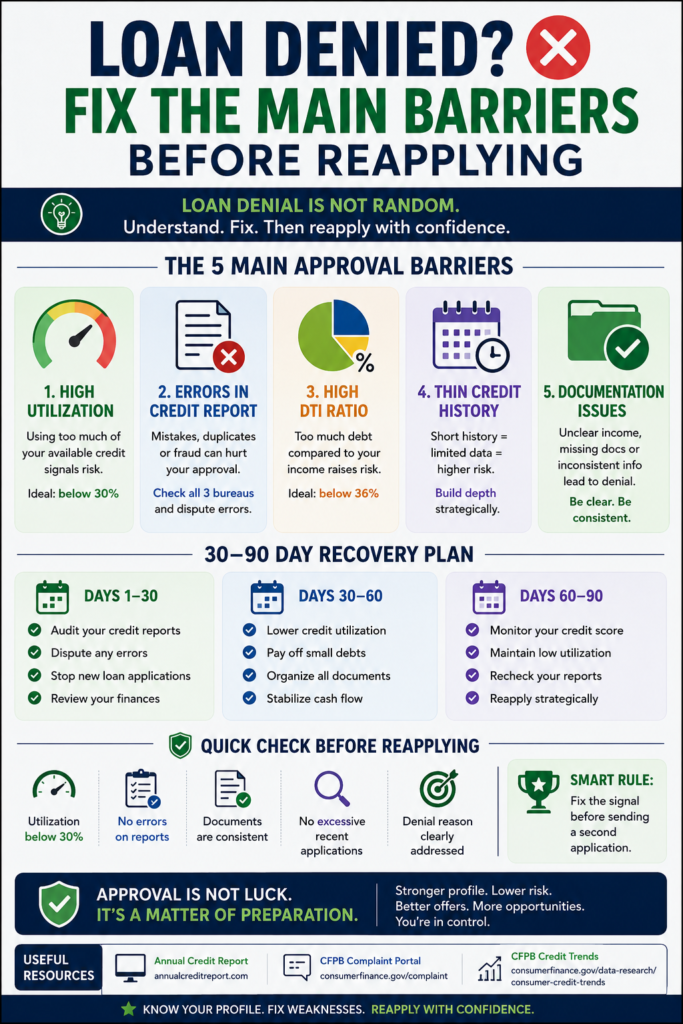
❌ Loan denial is not random.
It is usually a measurable signal that your profile needs repair before reapplying.
The 5 biggest approval barriers in the U.S.
Here are the five most common reasons applications fail in the American lending market.
High credit utilization
This is the silent killer.
Many borrowers have a “good” score but maxed-out limits.
Example:
| Total Limit | Current Use | Utilization |
|---|---|---|
| $10,000 | $8,500 | 85% |
| $20,000 | $6,000 | 30% |
| $30,000 | $2,500 | 8% |
Above 30%, underwriting begins tightening.
Above 50%, many models detect financial stress.
Above 80%, risk spikes sharply.
According to historical CFPB borrower-risk metrics, super-prime consumers maintain dramatically lower utilization than near-prime and subprime profiles.
How to fix it
- Reduce balances
- Request soft-pull credit limit increases
- Spread balances across accounts
Credit report errors
This is wildly underestimated.
The following can destroy approvals:
- Duplicate accounts
- Incorrect late-payment marks
- Fraudulent tradelines
- Inconsistent personal information
The CFPB continues to receive record complaint volume related to reporting disputes.
Our position is simple: Every American should audit their reports before applying for major credit.
Official source: Annual Credit Report
Review:
- Equifax
- Experian
- TransUnion
If you find errors, dispute them immediately.
Debt-to-income ratio (DTI)
Even a high score can fail here.
Lenders evaluate: How much of your income is already committed
Practical breakdown:
| DTI | Interpretation |
|---|---|
| Under 20% | Excellent |
| 20–35% | Healthy |
| 36–43% | Warning zone |
| Above 43% | High risk |
In U.S. mortgage underwriting, 43% is often the critical threshold.
Recent CFPB mortgage trend data shows increasing underwriting pressure around this range.
How to improve
- Pay off smaller installment debts
- Consolidate expensive debt
- Increase verifiable income
Thin credit history
This affects:
- Young adults
- Recent immigrants
- New banking entrants
You may have money. But without history, algorithms see emptiness.
And emptiness equals risk.
The smart fix: Build depth.
Useful tools:
- Secured credit cards
- Credit-builder loans
- Authorized user strategies
Documentation inconsistency
Very common among freelancers and self-employed borrowers.
Classic problems:
- Irregular income
- Incomplete statements
- Inconsistent tax filings
- Unexplained deposits
Banks do not approve stories.
They approve evidence. If your paperwork looks messy, underwriting assumes risk.
📉 High utilization
Signals cash pressure
📄 Bad reporting
Creates false risk
📊 Weak documentation
Blocks verification
The step almost nobody takes: request the adverse action notice
Under U.S. law, lenders must explain key denial reasons. Request it.
Analyze:
- Was the score too low?
- Was utilization too high?
- Was history too short?
- Was income inconsistent?
This turns emotional rejection into technical diagnosis.
Real recovery strategy (30–90 days)
Days 1–30
- Audit reports
- Dispute errors
- Pause all applications
Days 30–60
- Lower utilization
- Pay off micro-debts
- Organize documentation
Days 60–90
- Monitor score movement
- Stabilize account cash flow
- Reapply strategically
Practical case study
David, age 34, Phoenix. Denied for an auto loan.
Reasons:
- 78% utilization
- Excessive recent inquiries
- Experian reporting error
Plan: He corrected the report.
- Paid down $2,800 in card balances
- Waited 70 days
Result: His score increased by 49 points.
He was approved with a dramatically lower APR.
Same income. Same job.
The only difference was a repaired profile.
The biggest lie in the market
“If you were denied, just try another lender immediately.”
That message exists because intermediaries profit from application volume.
Not from your financial health.
Our view is direct: Applying again without fixing the root cause is financial noise.
You do not need persistence.
You need improvement.
🔥 Smart rule:
If you were denied, fix the signal before sending a second application.
Useful resources
Official reports: Annual Credit Report
Dispute complaints: CFPB Complaint Portal
Official trend data: CFPB Credit Trends
Checklist before reapplying
✓ Utilization below 30%
✓ No bureau errors
✓ Clean documentation
✓ No excessive recent applications
✓ Denial reason clearly corrected
Without these, reapplying is gambling. And intelligent credit never depends on luck.
Take it with you
Save this image and prepare wisely after a loan denial.
Frequently Asked Questions
Conclusion
In the United States, credit approval is not a reward for effort.It is risk mathematics.
The system does not care whether you “deserve” approval.
It wants statistical evidence that you will repay.

Related content
Compare Health Insurance Costs
Compare health plans using total cost and risk, not just premiums, during open enrollment decisions.
Keep reading * You will remain on the current website