
How to Align Your Bills with a Biweekly Paycheck
Learn how to manage biweekly paychecks effectively and align your monthly bills to avoid cash gaps and build financial stability.
How Your Pay Schedule Affects Your Bill Timing
In the United States, about 43% of workers are paid on a biweekly basis, according to data from the Bureau of Labor Statistics.
This means receiving 26 paychecks per year, instead of the traditional 24 in a semimonthly model.
In theory, it sounds like an advantage. In practice? It can turn into financial chaos.
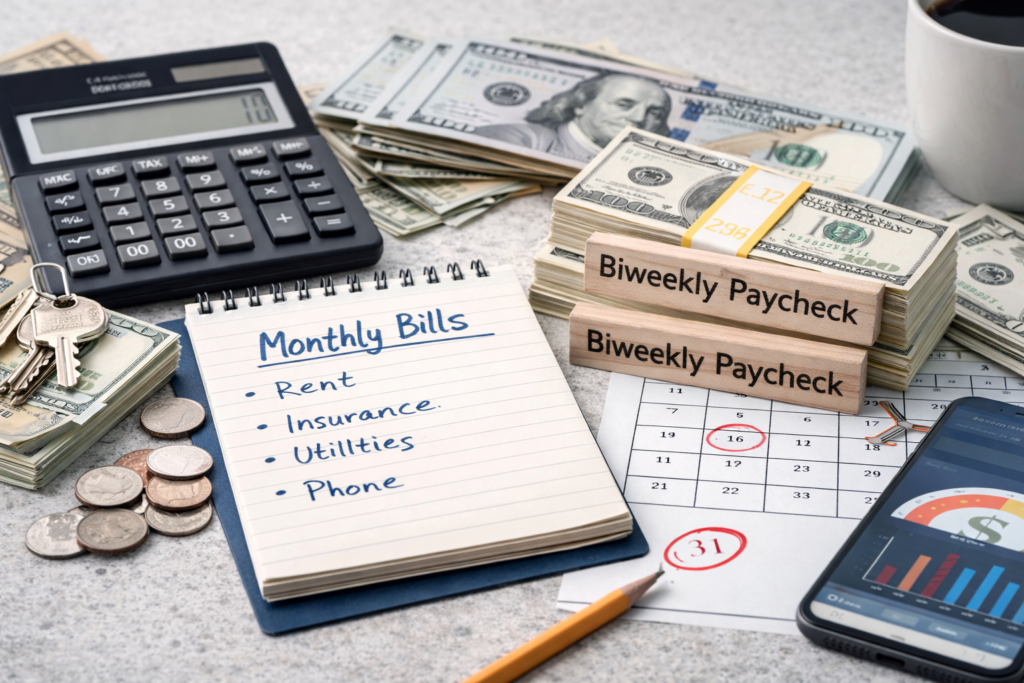
The problem is simple: your bills are monthly, but your income doesn’t follow that pattern.
This mismatch can lead to running out of money at the end of the month, late payments, and unnecessary reliance on credit.
The good news is that there’s a smart way to align everything—and that’s exactly what you’ll learn here.
How a Biweekly Paycheck Actually Works
Before organizing your finances, you need to understand the real impact of this payment structure.
How it works:
- You get paid every 2 weeks
- Total: 26 paychecks per year
- In 2 months of the year, you receive 3 paychecks
📊 Example:
- Biweekly salary: $2,000
- Annual income: $52,000
- “Extra paycheck” months: 2 times per year
The “third paycheck” is the key to the strategy.
The Real Problem: Monthly Bills vs Irregular Income
Most expenses in the U.S. follow a fixed monthly pattern:
Main monthly bills: rent/mortgage, insurance (auto, health), internet and phone, electricity and utilities.
Now compare that to your income:
| Type | Frequency |
|---|---|
| Bills | Monthly |
| Salary | Biweekly |
This misalignment is what creates financial imbalance.
Common Mistake: Paying Everything at Once
Many people do this:
- Receive a paycheck
- Pay as many bills as possible
- Run out of cash before the next paycheck
📉 Result:
- Credit dependency
- Financial stress
- Lack of control
Strategy 1: Split Bills by Paycheck
Instead of thinking monthly, think per paycheck.
Practical example:
| Paycheck 1 | Paycheck 2 |
|---|---|
| Rent (50%) | Rent (50%) |
| Internet | Credit card |
| Insurance | Electricity |
This creates balance throughout the month.
Strategy 2: Build a Financial Buffer
This is one of the most common strategies used by financially organized Americans.
How it works:
- Save the equivalent of 1 month of expenses
- Use it as a financial cushion
Data shows that people with a one-month buffer are 60% less likely to miss payments.
Strategy 3: Use the 2 Extra Paychecks
Remember the two months with 3 paychecks? That’s where most people get it wrong.
Smart use:
- Pay off debt
- Build an emergency fund
- Invest
Wrong use:
- Impulse spending
- Unplanned travel
Real data: over 70% of people spend the extra paycheck without a strategy, according to U.S. financial surveys.
Table: Monthly Planning Example
| Category | Monthly Amount | Per Paycheck |
|---|---|---|
| Rent | $1,500 | $750 |
| Utilities | $300 | $150 |
| Insurance | $200 | $100 |
| Food | $600 | $300 |
| Total | $2,600 | $1,300 |
This makes it easier to control your money in real terms.
Practical Checklist to Organize Everything
✔ List all your monthly bills
✔ Divide amounts by 2
✔ Align with your pay dates
✔ Build at least a small buffer
✔ Plan for months with 3 paychecks
Special Tip (Our Signature Insight)
Here’s an insight that makes a big difference:
Create a “Smart Bill Calendar” based on actual dates—not months.
How to do it:
- Organize bills by due date
- Match each bill to the closest paycheck
- Use a simple tool (spreadsheet or app)
You control the flow of payments. That completely changes your relationship with money.
Mistakes You Should Avoid
- Ignoring the months with 3 paychecks
- Not building savings
- Mixing fixed and variable expenses
- Relying on credit to fill gaps
Conclusion
Managing bills with a biweekly paycheck isn’t about earning more—it’s about managing timing better.
In the United States, where the cost of living is high and credit is easy to access, small organizational mistakes can turn into major financial problems.
But with the right strategies, you gain control, avoid debt, and build stability.
Frequently Asked Questions (FAQs)

Related content
Authorized User Removal: How It Affects Credit
Learn how authorized user removal impacts your credit score and discover smart strategies to minimize damage and rebuild fast.
Keep reading * You will remain on the current website