
Protect Your Home: Build an Inventory Before Storm Season
Learn how to build a home inventory before storm season and protect your assets with smarter documentation.
How to Create a Home Inventory Before Storm Season
Do you know how to properly build a home inventory before storm season?
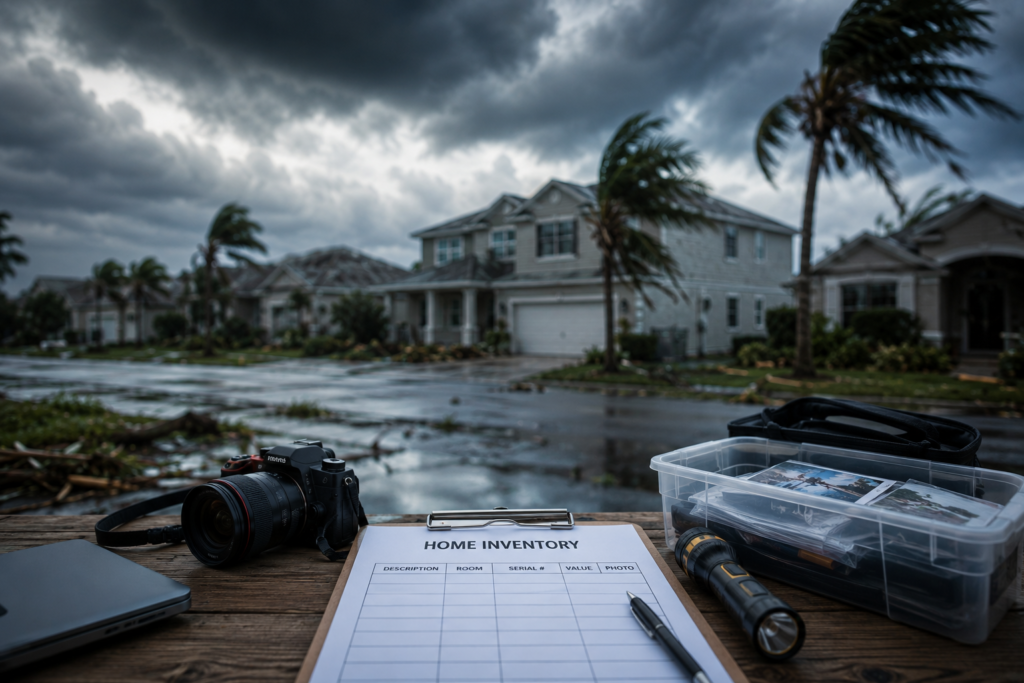
In America, storms are no longer rare events. They have become part of the real cost of homeownership.
If you still treat storm season as a “maybe,” you are mismanaging your assets.
And let’s be direct: substantial wealth requires substantial discipline. The numbers leave no room for romanticizing risk.
Dangerous Numbers
Between 1980 and 2024, the United States recorded 403 billion-dollar weather disasters, totaling more than $2.9 trillion in damages.
In 2025 alone, there were 23 billion-dollar events, with estimated losses of $115 billion.
The Reality of Climate Risk
If you own a home and do not maintain an updated residential inventory, you are taking an unnecessary financial risk.
Our position is simple:
If you own a home and do not maintain an updated residential inventory, you are taking unnecessary financial risk.
Understanding how to strengthen your financial resilience starts with building an efficient home inventory before storm season arrives.
The Most Expensive Mistake American Homeowners Make
Most homeowners believe their insurance policy is enough.
It is not.
When an insurer processes a claim after a hurricane, tornado, flash flood, wildfire, or storm surge, it demands documented proof.
Without proof, you do not “negotiate.”
You are arguing against a company with entire teams trained to reduce payouts.
Here is the typical outcome:
The Adjuster’s Reality Matrix
Complete Inventory
Receipts + Photos + Logs
Partial Inventory
Memory + Few Photos
No Documentation
“I remember it was expensive”
Insurance companies do not operate on emotional memory.
They work with verifiable evidence.
Your “I remember it was expensive” is worth nothing.
What Exactly Is a Home Inventory?
A home inventory is a detailed financial record of your household assets.
It includes:
- Item description
- Brand
- Model
- Serial number
- Purchase date
- Purchase price
- Current estimated value
- Photos
- Videos
- Receipts
- Documented upgrades
This turns abstract ownership into provable financial assets.
Financially sophisticated people understand one simple truth:
What is not documented is not protected.
The Real Financial Cost of Failing to Document
The Federal Emergency Management Agency (FEMA) explicitly recommends maintaining a home inventory as a critical part of financial preparedness.
There is good reason for this.
After major storms, homeowners often underestimate losses by 20% to 40% while trying to reconstruct details under stress.
Consider an upper-middle-class home in Texas:
| Category | Estimated Value |
|---|---|
| Electronics | $18,000 |
| Furniture | $35,000 |
| Office equipment | $8,500 |
| Sports equipment | $6,000 |
| Jewelry and watches | $12,000 |
| Premium appliances | $15,000 |
Total: $94,500
If you forget just 25%, you lose:
$23,625
That is not a small operational oversight.
That is silent wealth destruction.
📉 The Cost of Forgetting
Enter the estimated value of everything inside your home. See what happens when memory fails during a crisis.
The States Where This Matters Most
Not all climate risks are equal.
These are the most exposed states today:
| State | Primary Risk |
|---|---|
| Florida | Hurricanes and flooding |
| Texas | Hail, tornadoes, flooding |
| California | Wildfires |
| Louisiana | Hurricanes and storm surge |
| Oklahoma | Tornadoes |
| Colorado | Hailstorms |
| North Carolina | Coastal storms |
Average claim costs have risen sharply because severe weather events are becoming both more frequent and more expensive.
If you live in these markets without a home inventory, you are behind.
The Best Tools for Residential Inventory Management
The Professional Method for Building Your Inventory
Work by zones. Never document impulsively.
Step 1: Exterior Assets
Document:
- Roof
- HVAC systems
- Solar panels
- Fencing
- Security cameras
- Premium landscaping
- Storage sheds
- Pool systems
Many homeowners forget these assets.
That is an expensive mistake.
Step 2: Major Interior Spaces
Record continuous video walkthroughs of:
- Living room
- Kitchen
- Home office
- Bedrooms
- Closets
- Garage
Open drawers. Show interiors. Capture context.
Step 3: High-Value Items
Document in detail:
- Serial numbers
- Receipts
- Certificates
- Appraisals (when applicable)
Premium assets require premium documentation precision.
Step 4: External Backup Storage
Never keep your inventory in only one location.
Use:
- Cloud storage
- External SSD
- Physical fireproof safe
- Secure family sharing access
Redundancy protects wealth.
The Biggest Mistake Wealthy Americans Make
They insure their assets but neglect documentation.
It is surprisingly common to see million-dollar homes with worse inventory systems than college apartments.
This happens because higher income often creates false confidence.
And confidence without process becomes vulnerability.
Sophisticated assets require operational discipline.
Always.
The Ideal Update Frequency
Update your inventory after:
Protocol: When to Update Your Inventory
Storm season does not wait for your organization. It tests your preparation.
Storm season does not wait for your organization. It tests your preparation.
The Most Common Emotional Mistake
Many people avoid building an inventory because they think “planning for disaster invites bad luck.”
That is financial irrationality.
No one avoids an audit by ignoring accounting.
No one prevents fire by ignoring smoke detectors.
Preparation does not attract disaster. Preparation reduces loss.
The True Role of a Financially Mature Homeowner
Owning a home is not just about paying a mortgage.
It is about managing asset risk.
That includes:
- Proper insurance coverage
- Strategic deductible selection
- Flood coverage gap analysis
- Complete documentation
- Annual policy reviews
Anyone who ignores this is not investing in real estate.
They are gambling.
Our Honest Conclusion
If your home disappeared tomorrow, could you prove every lost asset?
If your answer is “sort of,” you are not protected.
You are exposed.
America’s reality has changed.
Storms are more frequent, claims are more complex, and insurers are more aggressive in validating documentation.
Our position is clear:
Every American homeowner should treat home inventory the same way they treat tax filing: mandatory, technical, and non-negotiable.
Because when the next storm arrives, the winner is not the person with the best memory.
It is the person with the best documentation.
Frequently Asked Questions

Related content
What Credit Card Purchase Protection Really Covers
Learn what credit card purchase protection really covers and how smart U.S. consumers use it to reduce risk.
Keep reading * You will remain on the current website What Credit Card Purchase Protection Really Covers
Keep reading You will remain on the current website